What Happened When I Finally Let Myself Be a Wellness Beginner — Every Single Day

For a long time, my relationship with wellness looked like this: I would get inspired — a new skincare routine, a fitness plan, a nutrition reset — and I would commit to it completely. I'd buy the things, clear the schedule, tell a few people about it so I'd feel accountable. I was in.
And then, somewhere between day four and day twelve, I'd miss a day. Or I'd do a watered-down version because I was tired. Or I'd eat the thing that wasn't on the plan because it was a Tuesday and I was stressed and the chips were right there.
And then I'd feel like I'd blown it. And then, usually, I'd stop.
This cycle repeated itself so many times across so many different wellness categories that I stopped counting. Skincare routines abandoned after one skipped night. Workout streaks "ruined" by a rest day I actually needed. Meditation practices dropped the moment I missed a morning and decided I wasn't a "morning person" after all.
The all-or-nothing mentality had me trapped — and the frustrating thing was that I knew it. I could identify the pattern clearly. I just couldn't seem to get out of it.
The Moment I Got Tired of My Own Perfectionism
The breaking point was, of all things, a yoga class.
I'd been going consistently for about six weeks — which, for me, was practically a world record. Then I had a genuinely brutal work week, skipped three classes in a row, and felt so behind and so guilty that I never went back. I drove past the studio for months afterward with a faint sense of shame.
Later, talking to a friend about it, I heard myself say: "Once I break the streak, it just feels pointless to go back."
She looked at me like I'd said something unhinged. And when I replayed it out loud, I kind of agreed with her.
I had been treating wellness like a performance review. Either I was hitting my metrics or I was failing. There was no room for a human middle ground — for a tired Tuesday, a hard month, a season of life where showing up at 40% was genuinely the best I had.
What "Permission to Be Bad" Actually Looks Like
I want to be clear that this is not a story about lowering your standards or deciding effort doesn't matter. It's a story about divorcing effort from identity — about separating the doing of a thing from a verdict about who you are.
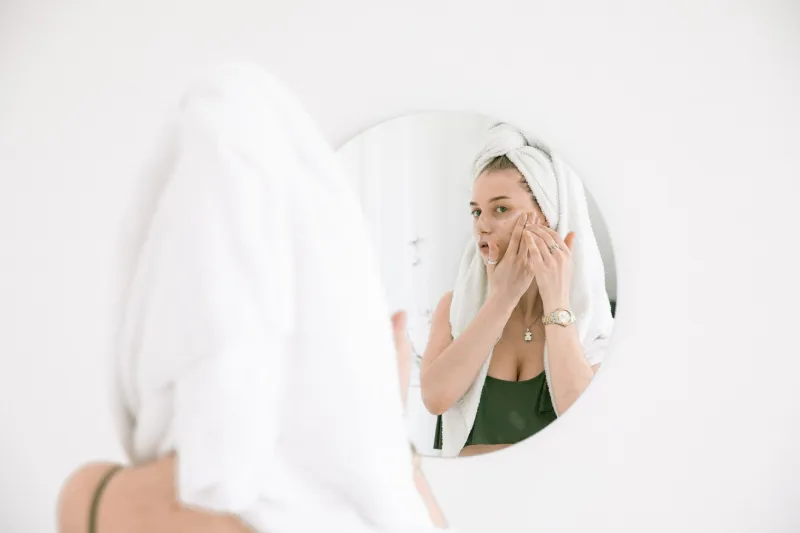
I started with skincare, because it felt lower stakes. My routine had always been elaborate — multiple steps, specific order, the full thing every morning and night or it felt incomplete. So I gave myself a new rule: something is always better than nothing.
On a night when I was exhausted, I didn't have to do the whole routine. I could just wash my face and put on moisturizer. That counted. That was not failure. That was a Tuesday.
At first, this felt like cheating. Like I was letting myself off the hook in a way that would eventually mean I stopped caring entirely. But the opposite happened. Because I'd removed the all-or-nothing pressure, I stopped dreading the routine on hard nights. I stopped building up resentment toward it. And most nights, once I'd started with the basics, I'd do a few more steps anyway — not because I had to, but because I actually wanted to.
The minimum viable routine became a gateway, not a ceiling.
Applying It to Fitness (The Hard One)
Fitness was harder. The wellness industrial complex has a lot of opinions about consistency in this department, and I'd absorbed most of them. The idea that a workout "doesn't count" if it's under thirty minutes. That you need to be sore to know you worked hard enough. That rest days are fine but too many rest days mean you're losing progress, losing momentum, losing the version of yourself you were trying to build.
I decided to experiment with what I can only describe as laughably low bars.
On days when I didn't want to work out, I'd ask myself: what's the smallest version of movement I could do that I wouldn't resent? Sometimes that was a ten-minute walk. Sometimes it was stretching on my living room floor while watching TV. Sometimes it was one set of something before deciding I was done.
And something strange happened. I stopped skipping entirely. Because "going for a ten-minute walk" doesn't trigger the same psychological resistance as "completing a forty-five minute workout." The bar was so low I could always clear it. And sometimes — not always, but sometimes — I'd get started and keep going because it turned out I had more in me than I'd thought.
The all-or-nothing approach had been keeping me from doing anything on the days I couldn't do everything.
The Skincare Lesson That Took Me Too Long to Learn
This same logic applied to nutrition and beauty habits in ways I hadn't expected. I'd been treating "eating well" as a binary — I was either on track or I wasn't — which meant one unplanned meal could derail an entire week mentally, even if it had no real physical impact.
When I started applying the "something is better than nothing" principle to food, I stopped treating individual meals as moral events. A salad at lunch doesn't erase the fries from dinner, and the fries from dinner don't erase the salad from lunch. They're just meals. They're just days. They accumulate into patterns over time, and patterns are what actually matter — not any single data point.
This is not a revolutionary nutritional insight. But emotionally, it was one I had to arrive at myself before it stuck.
What Actually Changed
Six months into this experiment, my habits are messier than they were when I was in peak optimization mode. My skincare routine varies by night. My workouts are inconsistent by any strict definition. I don't have a perfect streak of anything.
But I'm also still doing all of it. I haven't quit. I haven't burned it down and started over. I haven't spent a single Sunday spiraling about how I blew my routine and need to start fresh on Monday.
I just keep going. Imperfectly, inconsistently, sometimes barely — but going.
It turns out that sustainable isn't the same as perfect. And for me, at least, the willingness to do it badly was the only thing that ever let me do it at all.